For fifteen years, marketing has worshipped at the altar of programmed precision targeting.
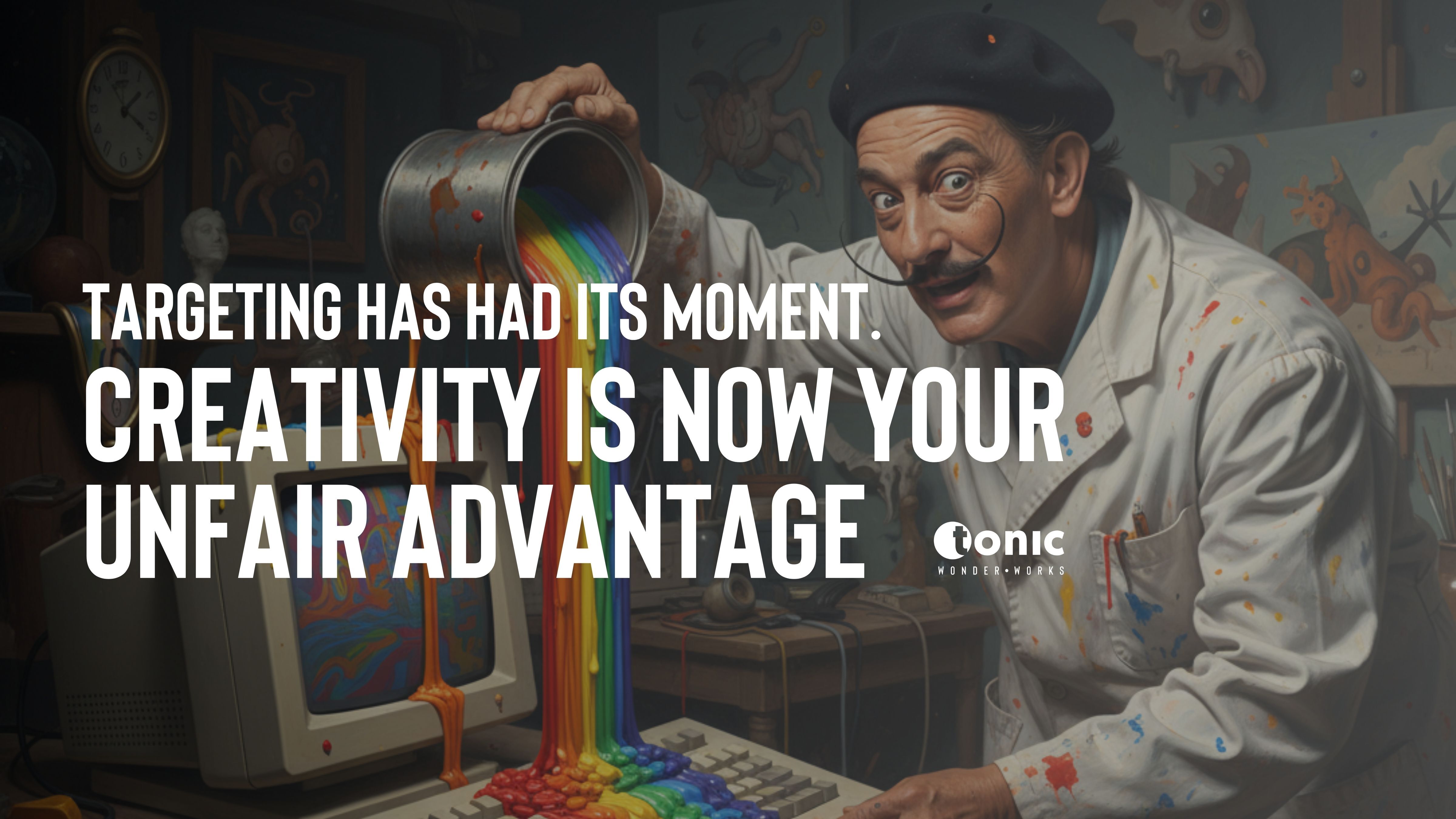
But now creativity has become the last bastion of unfair advantage.
Right Person. Right Time. Right Message. More Sales.
And to be fair, it worked. The internet allowed us to move from broadcast guesswork to data-driven confidence. If you could define your audience well enough, the platforms would deliver them to you.
It felt scientific. Efficient. Sensible.
Advertisers told the platform who to target. Age. Interests. Job title. Behaviour. The system obediently filtered ads to match those inputs.
Then AI arrived, and quietly made targeting very boring. More and more AI slop? No thanks.
Now the system starts somewhere else entirely.
Take Meta's new AI ad engine, Andromeda. Instead of asking "who should see this ad?" it asks, "which ad is most relevant to this person, right now?" And it evaluates millions of creative permutations in real time to decide.
That's a profound shift. The advantage is no longer in narrowing the audience. It's in giving the machine something interesting to choose from.
When everyone has access to the same targeting tools, targeting stops being a differentiator. It becomes hygiene.
You can't build competitive advantage out of hygiene.
What the algorithm increasingly reads isn't your audience settings. It reads your creative signal. Your imagery. Your hooks. Your emotional cues. Your distinctiveness. Broad targeting often works better than micro-segmentation because the system needs freedom to learn.
In other words, we've optimised the delivery van. But now the only thing that matters is what's inside it.
And this has real implications for employer brand management
Talent teams have adopted the same precision mindset as the wider marketing community. Personas. Micro-campaigns. Highly segmented messaging. It feels disciplined. It feels modern.
But if every employer is targeting the same engineers on the same platforms using the same optimisation tools, then the battle isn't happening in the audience dashboard.
It's happening in the idea. AI hasn't made creativity less important. It's made it structurally more valuable.
In a feed curated by machine learning, attention is the currency. Algorithms amplify what people engage with. They suppress what they ignore. Which means that your employer value proposition doesn't compete on reach alone. It competes with interest.
The uncomfortable truth is this: you can reach exactly the right candidate and still be invisible.
Creativity is what makes relevance visible
For employer brand management teams, this changes where effort should go. Not away from insight or data, but towards a stronger interpretation of that insight. Towards clearer propositions. Bolder articulations. Multiple distinct expressions of the same core truth.
Because if the system is choosing which message wins in each micro-moment, you need more than one way to be compelling.
Targeting still matters. Of course it does. But it's infrastructure now. Not a brand strategy.
Creativity is the advantage.
And when the infrastructure is democratised, advantage becomes psychological, not technical.
That's good news.
Because psychology has always been where brands win.
.png)