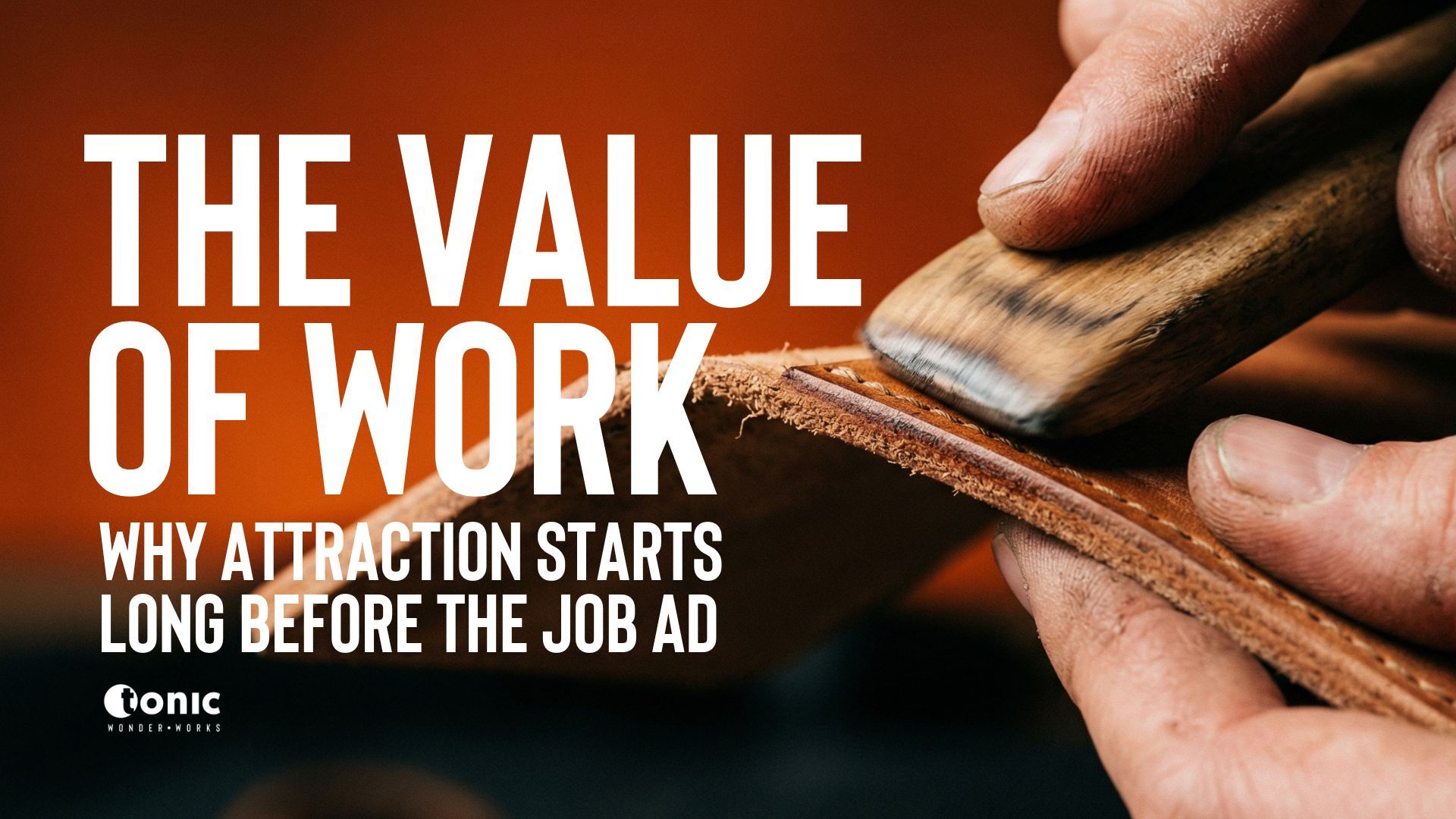
If engagement is falling and burnout is rising, recruitment may have a deeper challenge on its hands: helping people believe that the work itself is worth doing.
For years, recruitment communications has been treated largely as a marketing challenge. Write a compelling job ad, target the right audience, streamline the application journey and the candidates will come.
But lately it feels like the conversation has shifted…
I talk to people all the time about their careers (yes, I’m a terrible bore in social settings!) and I’ve noticed a slightly different question keeps surfacing. It’s not always “Where should I work next?”. It’s “What role should work play in my life at all?”. In the years since the pandemic, people’s relationship with work has changed in ways many organisations (and the individuals themselves) are still trying to understand. The psychological contract hasn’t disappeared, but it has quietly been renegotiated.
And because I’m not one to just take things at face value, I decided to find some stats that back up the anecdotal evidence I’ve been hearing. The data tells a striking story:
- Gallup’s latest global workplace research shows that only 21% of employees feel engaged in their work[1], meaning nearly four out of five people are either disengaged or actively disengaged.
- At the same time, stress and burnout remain stubbornly high. In the UK, 63% of employees now show symptoms associated with burnout, while 79% report moderate to high levels of workplace stress[2].
- And perhaps most tellingly, global workforce research from PwC shows that employees who find their work meaningful are 91% more motivated than those who don’t[3] - yet only around half of workers say they’ve actually found that sense of meaning in their jobs.
Taken together, it paints a picture of a workforce that hasn’t stopped working, but has started questioning work.
This doesn’t mean people suddenly want to opt out of careers. Most people I talk to still want progress, security and a sense that their efforts matter. But the last few years forced many people to pause and reconsider how much of their time and energy they are willing to give to their jobs, and what they expect in return. That shift matters enormously for recruitment. Because if someone is unsure about the value of work itself, persuading them to apply for a particular job becomes much harder.
Traditional attraction strategies still focus on the mechanics of hiring. Better targeting. Sharper messaging. More polished campaigns. All important things. But they don’t solve the deeper issue I’m seeing. You can optimise the job ad. You can streamline the application process. You can invest in more creative campaigns. But you can’t out-market a role that doesn’t feel worthwhile.
Clients tell me that candidates are making a more fundamental calculation when they consider a job. Not just whether the employer is appealing, but whether the work fits into the life they want to build. In practice, those decisions often come down to three simple questions.
- Will this move my life forward?
People still want progress. A sense that their time at work is taking them somewhere. - Does this fit who I am?
Work has always been tied to identity, but that link has grown stronger. People want their jobs to align with their values, not fight against them. - Will this actually matter?
Not necessarily in a grand, world-saving sense. But people want to feel that their work contributes something meaningful beyond a never-ending list of tasks.
That’s where insight becomes incredibly important. Before any campaign, creative concept or media plan, there’s value in stopping to ask a more fundamental question: what is it about this work that should matter to someone?
At Tonic, a big part of what we do sits in that deep-thinking space. Through research, talent insight and audience understanding, we help organisations step back and look at the role they’re about to advertise from the candidate’s perspective. What motivates the people you’re trying to reach? What do they value? And where does this role genuinely connect with those priorities?
Because when you position the work itself clearly and honestly, the marketing becomes far more powerful. Attraction doesn’t start with the job ad. But when the thinking upstream is right, the job ad suddenly has something real to say.
[1] https://www.gallup.com/workplace/697904/state-of-the-global-workplace-global-data.aspx
[2] https://mhfaengland.org/mhfa-centre/blog/Key-workplace-mental-health-statistics-for-2024
[3] https://www.pwc.com/gx/en/issues/workforce/hopes-and-fears.html